decoding adult autistic meltdowns

Tag: disability

A Bridge Between Silos

Image description: A large natural stone arch spans between two rocky cliffs in Virginia. The arch is made of gray and tan limestone, with green trees growing along the top and on both sides. The view through the opening shows a bright, cloudy sky surrounded by dense forest.

The Child No One Wanted in Class

A recent New York Times article (October 1, 2025) suggesting autism needs to be broken into two categories cited “a survey of 800 families, conducted this year by the National Council on Severe Autism, [which] found that 80 percent had been told their children were too disruptive even for classrooms and services tailored to students with autism and other disabilities.”

While no one would accuse me of having “severe autism,” I, too, was an unwanted, disruptive presence in my classrooms. My kindergarten teacher loved me, even though I bit her when she tried to pull me out from under the table where I was hiding. My first grade teacher hated me and requested I be removed from her classroom and put in special education. She called me the R-word. 

When I think back on elementary school, it’s hard to remember what happened, where. I changed schools so many times I’d been in at least six different schools by fourth grade. Sometimes there were other reasons for shuffling me around, but I was removed from many classrooms because teachers couldn’t handle me. No one knew what to do with me. 

I’d slither on the floor like a lizard. I’d meow like a cat. I’d take any opportunity to hide under a table where it was darker, quieter, less overwhelming. My emotions erupted straight through my skin with no regulator, no buffer. My outbursts and disruptions became louder and more appalling the older I got. By middle school, I’d gotten myself expelled from the entire county school system. There was no place back then for someone who was both academically gifted and behaviorally disabled. 

They have a word for it now: twice exceptional. 

I hope they have more than a word. 

I hope kids like me actually have a place now. 

A Spectrum With No Middle

I grew up to find “my people”… sort of. Maybe. 

There’s a current cultural argument: autism should be split into “profound” and “non-profound” autism. Researchers have joined the debate, studying where to draw the line and how to justify it. Quoted in the Times article, Ari Ne’eman, long-time Autistic self-advocate, compared the attempt at separating autism into two camps to trying to “cleave a meatloaf at the joints.” 

I don’t belong on either side. Will that cleaver chop me in two?

My life keeps proving what the research hints at: the middle of the spectrum is where services, language, and understanding fall apart.

Services for “profound autism” will not help me. I speak, I write, I drive. I don’t require 24/7 supervision. I remember the days when those services were the only thing there was. I was drowning in my own life and no one would help me because my IQ is higher than 70. These are services only available to people who can’t ask for them. 

But support and services for “non-profound autism” leave me behind, too. I have a hair-trigger nervous system. I become “profoundly” dysregulated and cannot “behave appropriately” in systems where no one is trained on the nuclear level meltdowns that overtake my bodymind in times of intense stress. My sensory sensitivities are calibrated so finely that I can barely stand to be around people (despite being an extrovert who loves human connection.)

I belong to the messy middle. We fall through the cracks.

The Lived Middle

When I read about the proposed split, profound vs. non-profound, I can see what each side is trying to describe, but (like many Autists…most Autists?) I live in the space between them. I don’t need someone to monitor my every move for my safety. But I do need someone who understands that my nervous system runs like a live wire, and that a “simple” social misunderstanding or a flickering fluorescent light can send me spiraling into hours of recovery.

I can cook, drive, write, edit, and facilitate groups. I can also lose the ability to speak for days. I can manage complex projects for work, then fall apart because someone touched me in the grocery store. When I melt down, my brain doesn’t politely announce, “please excuse the emotional disturbance.” It shuts down my access to my prefrontal cortex (while leaving my brain’s language center dismayingly untouched!) and throws me into a physical storm that feels like experiencing every threatening emotion in one giant tsunami.

I am neither the non-speaking child in a residential facility nor the worker who has kept the same job for twelve years (though not, I should note, without suffering or struggle). I am the missing middle case: the one who gets lost when systems are built for either the child who can’t communicate or the adult who can network.

If autism is divided, where will people like me go? “Profound” autism categories will not include me because I can speak. “Non-profound” services will exclude me because I cannot perform neurotypicality sufficiently to keep a job more than a few months. When I am regulated, I can explain my meltdown with elegant clarity; when I am in it, all I can do is scream obscenities. This same body holds both truths.

The danger of the cleaver isn’t just that it divides. It crushes the connective tissue. We mid-gradient people prove that autism isn’t a tidy collection of buckets but a terrain of overlapping ranges. We are the fault lines that make the whole visible.

The Scientific Lens, the Polygenic Divides

A 2025 study in Nature Medicine put forth the thesis that autism looks different depending on when someone is diagnosed. Researchers tracked thousands of children and found two main developmental arcs: one that emerges early, and one that surfaces later. The early group, usually diagnosed around preschool age, showed strong signs of dysregulation and social difference from the start. The later group, those not diagnosed until adolescence or adulthood, looked more “typical” in early childhood, then began to struggle as social life grew more complex.

Genetically, those two arcs map onto different constellations of traits. The early group is tied to genes that influence social communication and sensory processing. The later group is tied to genes overlapping with ADHD, PTSD, and depression. According to the data, the two profiles are distinct enough that they could almost be seen as different “autisms.” Yet even the researchers left an undefined window between ages six and nine, a no man’s land where neither trajectory cleanly applies.

I land in that overlap zone. I have an early-identified nervous system carrying the later-diagnosed cluster of comorbidities. My life is where the two curves meet and tangle. I was initially diagnosed at seven (squarely between “early” and “late,” in the study’s framework) yet I live with both the extreme emotional dysregulation the study defined as a hallmark of early diagnosis and the ADHD, PTSD, and chronic struggle with anxiety and depression that the study found more common among later-diagnosed people. I’ve always been the statistical noise that refuses to average out.

The scientists used the word polygenic to describe how hundreds of genes combine to shape each person’s developmental path. I think of it as poly-everything: polytraumatic, polysensory, polymodal. I’m a multivariate outlier. My neurology carries multiple histories at once: genetic, experiential, cultural. I am early-emergent in my meltdown profile, late-emergent in my self-awareness, and forever trying to reconcile a body that feels ancient with a mind that keeps discovering itself anew.

When researchers talk about these two genetic “factors,” they still speak as though everyone fits neatly into one or the other. But so many of us are hybrid systems: early storms that never quieted, layered with late revelations. The data call me interstitial. I call it being alive at the seam where categories unravel.

Science likes to sort, but the closer researchers look, the more the borders blur. Each new study meant to clarify autism’s architecture ends up revealing new subtypes, new overlaps, new contradictions. Attempts to cage the spectrum only unravel into a cluster of intersecting constellations. Advocates of the “profound autism” label say there is not one autism. In truth, there are not two autisms, either. There are many autisms, coexisting and often colliding in combinations inside a single person. The data are only beginning to catch up to what many of us have lived all along: there is no single arc, no single story, no single way to be Autistic. It’s Ari’s meatloaf with traits thoroughly mixed throughout, not lined up as discrete slices.

An Ethical Gap: Diagnosis Without Disclosure

I was diagnosed at seven but first told at thirty-four. For twenty-seven years, I lived with the label but not the knowledge. The word autism lived in files, not in my awareness. Others had access to information that could have helped me make sense of my life, but no one handed me the map.

When researchers talk about age of diagnosis, they assume the person diagnosed actually knows. But there’s another trajectory that rarely enters the data: early-diagnosed on paper, late-diagnosed in life. On a chart, I’d be plotted among the “early” cases; in lived time, I belong with the “late.” With my mixed collection of traits, I belong nowhere. 

That’s one ethical vacuum in the whole conversation about splitting autism into “profound” and “non-profound.” What good are new categories if the people inside them still aren’t told who they are? The system can label a child, publish the data, even claim early intervention success — but if that same child grows up without language for their own difference, what intervention was that, really?

Diagnosis ≠ disclosure ≠ support. 

Knowing about me is not the same as letting me know myself.

The Human Cost of Polarization

Both sides of the split debate are reacting to genuine pain. The parents of children with high support needs see the more verbal Autists growing in numbers, eclipsing children like theirs, putting forth an ideology that they fear will leave their children behind. They’re fighting neglect in a world that offers little safety net, little respite, and too few clinicians willing to take on complex cases.

Neurodiversity activists, on the other hand, are fighting erasure. For years they were told they weren’t “really” Autistic, that they were just eccentric or socially awkward. Meanwhile, glossy “Autism Awareness” campaigns featuring celebrities peddle a narrative of tragedy, comparing autism to diabetes and cancer.

But between those two righteous causes lies a widening gulf that swallows anyone whose life defies both archetypes. When advocacy polarizes around who suffers “enough” to be considered truly Autistic, people like me flounder with few places to turn for useful help.

I was the child too disruptive for classrooms and too verbal for compassion. I lost school placements not because I couldn’t learn, but because no one knew how to teach someone like me. I carried untreated trauma for decades because professionals saw only defiance, not distress. Even now, the daily work of emotional regulation: holding myself together through noise, touch, light, and human unpredictability? It’s invisible labor few realize I’m slogging through every day. I don’t fit either narrative. I suspect most Autists don’t. Who is researching that?

For the “profound” camp, I’m too capable. For many in the “neurodiversity” camp, I’m too volatile. But my existence proves both realities true at once: the need for safety and care, and the right to self-definition. The binary breaks apart where I live.

My Life as a Bridge

When I call myself a bridge, I mean the structure, the connective tissue that holds two sides in relation. The middle is not an absence but an architecture. People like me show where the spectrum’s supposed endpoints bend toward each other.

My neurology is hybrid, not broken. It offers a way to see autism as an ecosystem rather than a spectrum line. Forests don’t divide cleanly into “trees” and “not trees.” They contain gradations of shade and soil, roots interlaced underground. Autism is like that: an ecology of traits and bodies that shape one another. To understand the whole, you have to study the overlap zones, the places where categories blur and organisms coexist.

If research and policy treated those overlaps as instructive instead of inconvenient, support could become scalable and individualized rather than categorical. A system built for complexity would ask different questions: not “Which kind are you?” but “What do you need, and what helps you thrive?”

This is an ethics of care that designs for the edges and intersections, not the average case. The bridge perspective doesn’t erase difference; it honors it by keeping the structure intact for everyone who lives between.

Reclaiming the Middle Ground

I think of that child on the classroom floor, hiding under a table because it was the only place that felt safe. The lights were too bright, the noise too sharp, the air thick with other people’s expectations. No one knew what to do with that child. The teachers wanted them gone. The files called them disruptive. But they were trying, in the only language they had, to build a bridge between their bodymind and the world.

What if the field saw that child not as an outlier, but as the center? What if the messy middle was understood as the heart of autism rather than relegated to its margins? Every diagnosis, every theory, every classroom could start from that question: what happens when we design for the ones who don’t fit cleanly anywhere? 

What if we center them in the story of their own life?

The future of autism can’t belong to the extremes alone. It belongs to us all: to those clearly defined and to those who live in the thresholds, translating between worlds, proving that connection itself is a form of intelligence. The spectrum’s strength has always been its range, and its hope lies in those who refuse to disappear into binaries.

That child is still here, learning to stand in the open. The world is finally beginning to meet them halfway.

It’s almost enough.

Works Cited

Ghorayshi, A. (2025, October 1). Should the autism spectrum be split apart? The New York Times. https://www.nytimes.com/2025/10/01/health/autism-spectrum-neurodiversity-kennedy.html

Zhang, X., Grove, J., Gu, Y., Buus, C. K., Nielsen, L. K., et al. (2025). Polygenic and developmental profiles of autism differ by age at diagnosis. Nature Medicine, 31(2), 225–238. https://doi.org/10.1038/s41586-025-09542-6

Autism Is a Developmental Disability, Not a Developmental Delay

(And Certainly Not a Developmental Halt!)

A split image of a freeway on the left and a country road on the right
On the left, a busy multi-lane freeway carries heavy traffic beneath a sky filled with scattered white clouds. Cars stream in both directions, stretching toward the horizon. On the right, a narrow country lane winds through rolling hills covered in grasses and patches of wildflowers.

For maybe twenty years, I’ve been saying autism is a developmental delay, not a developmental halt. 

Something I read today helped me realize that autism isn’t even a delay. I’ve written and spoken of autism as a different trajectory, a separate road. When we fail to meet developmental milestones, it’s because we’re not traveling the same road. 

 But today it struck me: traveling a different road means we really can’t be called delayed. Are apples delayed oranges?

The freeway is built for speed. Smooth blacktop, painted lines, endless streams of cars all moving in the same direction, at the same pace, toward the same destinations. It’s efficient, streamlined, and relentless. You don’t stop to notice much out there—just keep your foot on the gas, eyes forward, merging when you’re told, obeying the rhythm of the crowd.

The country lane is another world. Winding, uneven, with dips and bends that make you slow down, sometimes whether you want to or not. The air feels different on a country lane. You see the hawks circling above the fields, the wildflowers that grow between cracks, the way the light shifts when a cloud drifts in front of the sun. It’s slower, maybe—but it’s also fuller. You’re not just getting from point A to point B. You’re in the middle of a living landscape, taking in every detail, whether you asked for it or not.

The “Frozen in Time” Hypothesis

I started thinking along these lines after reading Jordan James’s take on autistic development. His metaphor was stark: autism as a kind of halted growth, “frozen” at different ages because of reduced synaptic pruning. In his view, some Autists remain infants in certain ways, others linger in childhood, still others carry pieces of teenagehood into adulthood.

It’s not hard to see why that framing resonates with some of us. Many Autists do describe feeling “younger,” or “out of sync” with peers. There are moments when the world treats us as if we’ve missed a step in growing up—and sometimes, it feels true inside our own skin. The sense of living on a different clock can be powerful, even haunting. 

But the science behind this metaphor doesn’t hold up. As  Dr. Nicolás F. Narvaez Linares, a pediatric clinical neuropsychologist at the University of Ottawa, pointed out in a comment on LinkedIn, pruning differences are variable, inconsistent, and nowhere near enough to justify sweeping claims about Autistic people being ‘frozen’ in time.

Worse, this conclusion risks being deeply damaging.

Lifelong Growth, Not Arrested Development

I think it’s more complex than the “frozen development due to clogged synapses” picture suggests. My own life has been full of growth—sometimes painfully so. I have changed, reshaped, and unfolded uncountable times. And I keep doing it. I’ve seen the same in Autistic friends, colleagues, clients—people manifesting a wide variety of “flavors” of autism.

In fact, one of the sharpest contrasts I have noticed is this: many allistic people seem “done cooking” by their mid-twenties. Their personalities stabilize, their habits take shape, and their ways of thinking become more consistent. 

It’s probably no coincidence that 25 is the age when insurance rates drop and society starts treating people as more settled. For most, the brain has finished maturing, impulsivity fades, and people tend to become more predictable, less changeable. 

Meanwhile, we Autists keep shifting. Still evolving. Still surprising ourselves with new insights, new ways of being, new patterns of thought.

Yes, I’m often pegged as younger than I am. I still love toys and cartoons. I carry a streak of naivety (though tempered now by memories of deception and betrayal.) But that doesn’t feel like arrested development to me. Quite the opposite. It feels like an ongoing capacity for renewal, a thirsty sense of wonder, a willingness to grow that doesn’t run out just because I crossed some birthday milestone.

This isn’t a deficit. It’s a gift. Autists have the ability to keep developing and changing all the way to our deathbeds. We are not halted, we are not stuck. We are alive to growth in ways most freeway drivers were never shaped to be.

What the Delay Framework Costs Us

The problem with calling autism a “delay” is that it traps us in a story that was never written for us. If development is imagined as a ladder, with rungs spaced at predictable intervals, then the assumption is that everyone is climbing the same structure and should be climbing at the same speed. In that model, Autists are forever stuck—still clinging to the lower rungs while everyone else rises higher.

That picture is not only inaccurate, it’s dangerous. It feeds infantilization: the idea that autistic adults are “really” children inside, no matter how many birthdays we’ve had or how much wisdom we’ve gathered. It justifies treating us as less capable, less autonomous, less deserving of respect.

And it ignores what is obvious to anyone who actually looks at us: we have spiky profiles. A spiky profile means strengths and challenges—relative to the neuromajority—sitting side by side in one person. Advanced in some areas, slower in others. Sometimes dazzlingly so, in both directions:

You might find a ten-year-old Autist who can recite astronomical data with the precision of a graduate student but struggles to tie their shoes. Or an adult who navigates complex systems of thought yet finds a grocery store overwhelming. You might meet a non-speaking Autist who points at letters with an eloquence that stops you in your tracks, yet who is still treated like a toddler because their sensory and motor issues affect when and how their bodies can show up. 

This isn’t “delay.” It’s not a single clock running late. It’s an entirely different rhythm, unfolding unevenly, sometimes ahead, sometimes behind, sometimes on a completely different path, always patterned in ways that don’t climb the standard ladder in the standard ways.

Attention, Not Distraction

Autists aren’t delayed freeway drivers. We’re lane travelers. We don’t simply move more slowly on the same road; we move differently, on different terrain altogether.

On the country lane, you notice more. The road itself demands it. The texture of bark on the cottonwoods. The exact angle of sunlight through a cloud bank. The sound of gravel crunching under your tires, each stone distinct. What the freeway calls distraction, the lane calls attention. We are immersed in the details, saturated by them, compelled to take in the whole landscape.

This is one of autism’s great strengths: sensory depth, environmental awareness, the kind of noticing that catches what others miss. But that same fullness can overwhelm. Just as a country lane can’t handle the crush of freeway traffic without crumbling, autistic systems can be swamped when environments overload us with noise, demands, or relentless pace. That is where disability lives—not in some imagined lateness, but in the mismatch between our ways of perceiving and the structures we’re asked to navigate.

Spiky Profiles Are Terrain

The spiky profile only looks strange if you’re measuring it against freeway norms. From that perspective, it seems contradictory: advanced here, behind there, uneven all over. But on the country lane, the landscape isn’t supposed to be level. It has ridges and valleys, sudden overlooks, unexpected twists. The spikes are not flaws in the road—they are the road.

What’s called “delay” in one domain and “giftedness” in another are simply features of a different ecology. The unevenness is not a mistake to be corrected, it’s the terrain we move through and with. On the freeway, a sudden rise in the pavement would be a hazard. On the lane, a hill is part of the view.

The spiky profile means that Autists often defy simple labels. A person might compose music with exquisite precision yet struggle to keep their clothes clean. Another might master three languages while needing help to cross a busy street safely. These contrasts are not contradictions. They are part of the same pattern—the ridges and valleys of a life lived on a different road.

Different Roads, Different Rhythms

Autism isn’t about lateness. It isn’t about arrested growth, clocks that stopped ticking, or children hidden inside adult bodies. It’s about terrain. It’s about rhythms. It’s about sightlines that open in directions others don’t even think to look.

We don’t move along a single track of “normal development.” We move through our own ecologies—sometimes winding, sometimes steep, sometimes dazzling in their vistas. Our paths aren’t broken freeways; they’re lanes of their own.

Disability emerges when freeway systems are imposed on lane travelers. When schools, workplaces, and public spaces are built with only speed and sameness in mind, they leave no room for those whose journeys are richer, slower, or less predictable. That mismatch—between the way we are built and the way the world is structured—is what most disables us.

What We Bring Back

Freeways will always get you to the city faster. That’s their purpose: direct, efficient, predictable. But the country lane takes you somewhere else entirely. It winds through hidden valleys, past streams no map bothers to mark, into places you would never have found at freeway speed.

Autists are not late arrivals, forever catching up to the crowd. We are travelers of another road. Our journey is not defined by delay, but by difference—by the sights we gather along the way, the details we bring back, the truths we carry from landscapes most people never see.

Is Autism a Disability? Are Autistics Disabled? (Are These the Same Question?)

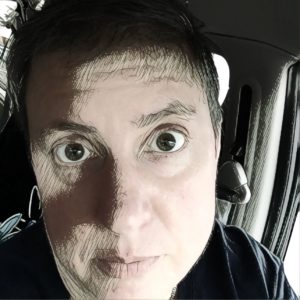
sketch sparrow

[image description: a photo of a middle-aged transmasculine person in a van, half-rendered into a sketch, using the Heisenberg setting in Prisma, turned down to 54%. Copyright 2016, Sparrow R. Jones]


I don’t like to engage in serious conversations on Twitter because I’m so quickly overwhelmed by the format, but yesterday I ended up in a corner of a discussion that spread throughout much of the Twitter Autistic community, as evidenced by this other excellent blog post addressing a different aspect of the conversation: Autism does not reside in a medical report.

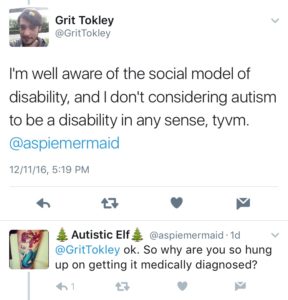
My corner of the conversation centered around the question of whether autism is a disability or not. The same person who stirred Sonia Boue to write the excellent post linked above got into it with one of my Twitter contacts on a different but related topic:

Tweet by Grit Tokley

[image description: A twitter exchange. Grit Tokley writes: “I’m well aware of the social model of disability, and I don’t considering autism to be a disability in any sense, tyvm. @aspiemermaid” Autistic Elf (Aspiemermaid) responds: “@GritTokley ok. So why are you so hung up on getting it medically diagnosed?”]

So, here I am, unpacking the social model (and a couple of other models) of disability and discussing the questions: Is autism a disability? and Why does it matter whether it is or not?

Because, of course, the bulk of the following Twitter discussion centered around strong assertions that autism is not a disability, along with strong assertions that everyone is entitled to their own opinion and we must all agree to disagree

*sigh*

So, with that.

Three Models of Disability

There are many different models of disability, but I would like to focus in on three of them as being the most mainstream and/or the most useful for various groups of people.

The Medical Model of Disability

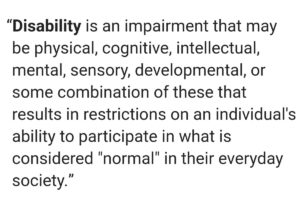
This is the most mainstream model of disability and the one you’re most likely to have seen before. One participant in the Twitter discussion shared this definition of disability that pretty well sums up the nicest version of the medical model you are ever likely to see:

medical model disability

[image description: a white background with black text reading: “Disability is an impairment that may be physical, cognitive, intellectual, mental, sensory, developmental, or some combination of these that results in restrictions on an individual’s ability to participate in what is considered “normal” in their everyday society.”

It’s sweet of them to put the word normal in quotes. Even with that nod, the medical model is basically saying that disability is entirely contained in the person identified as disabled. It’s all on you if you have impairments that restrict you. If you’re lucky, people will have a little decency and put some ramps in front of government buildings or braille placards on elevators, but mostly you just have to accept that you’re not normal and be grateful for what crumbs people toss your way. After all, you can’t expect everyone to go to the trouble and expense of making special accommodations just for you, right? Where would we be if we had to accommodate everyone’s impairments?

That’s the medical model and that’s why so many disabled people reject that definition of disability. But it’s still a really popular definition. And, as the person who shared the image pointed out, by this definition, autism is quite clearly a disability. Something like 99.9% of the Autistics you will meet have at least one of some kind of sensory issue that makes life difficult if/when they encounter sensory assaults (or situations in which they require extra sensory stimulation in order to stay regulated.) By definition, we are developmentally disabled, whether you use the medical model’s terminology (developmental delay) or recognize our development as being on a different trajectory from the mainstream. It’s pretty clear that, within the medical model we are disabled.

The Social Model of Disability

This is the model I see most often in the Autistic activist community. The social model was developed in the 1970s by British disability theorists who did not appreciate the way the medical model dumps all responsibility for disability and accommodations thereof in the laps of disabled people. The social model was a great improvement over the medical model, particularly in the area of human rights.

The social model posits that disability does not actually exist. Those states of being that are labeled as “disability” are natural variations in the human condition and all human beings require support and accommodation from society in order to survive. For example: you probably eat food that someone else grew, someone else processed and/or packaged, someone else drove to your region in a truck using fuel gathered and processed by someone else, driving on roads built by others and paid for collectively through taxation. All of the steps and people required to get food to the supermarket, farmer’s market, soup kitchen, restaurant, institutional kitchen or whatever location it is where you go to feed yourself are supports and accommodations that society approves of and works hard to keep in place.

When the need is a mainstream one, the supports and accommodations are called “infrastructure.” When the need is a divergent one, the supports and accommodations are called accessibility measures. According to the social model, “disability” is a social construct and “disabled” is what society is doing to you if it decides that the supports and accommodations you require are too much trouble and you are not worth the expenditure of time, energy, money, and other resources that would be required to make society accessible to someone like you.

Within the social model of disability, Autistics are disabled (by a society that does not value Autistics sufficiently to support and accommodate us) but autism is not a disability because disability does not exist, being merely a social construct that makes it convenient for those who would like to disable us without feeling guilty about it.

The Social-Relational Model of Disability

Finally, we have my favorite model of disability, the social-relational model. The social-relational model is less well-known, having only been developed in the 21st century, by disability theorist Solveig Reindal1. The need for the social-relational model was clear before Reindal wrote about it, though, and I’ve also noticed some people who are unaware of Reindal’s work trying to re-shape the social model into something closer to Reindal’s vision, due to dissatisfaction with the social model. No need to re-shape the social model, though, when the social-relational model already exists.

The major dissatisfaction activists and theorists were finding with the social model was that disabled people could not express any dissatisfaction with the experience of being disabled without being viewed as “traitors to the theory.”2. Reindal’s new formulation of the social-relational model moves to a third position in which society is still held accountable for disabling people but theory does not ignore the body or the real struggles some people have with disability, independent of society’s support and accommodations or lack thereof.

While the social model claimed that disability does not exist, being purely a social construct evolving out of views of those constructed as disabled as being “lesser” in some way, Reindal acknowledged that those who are identified as disabled do, indeed, have some type of impairment. These impairments – what the medical model calls “disability” – Reindal labeled as “barriers to doing.” In contrast to impairment, Reindal writes about “being disabled” as it is defined by the social model as the “barrier to being,” suggesting that the social constructs that view those with impairments as lesser beings, not worthy of inclusion or accommodation, creates an existential crisis that extends deeply into the disabled person’s core being.

Within the social-relational model, I have impairments (although not all Autistics have social-relational impairments, according to what others have told me) and I am disabled by society’s lack of support and accommodation for my needs. I have a disability and I am disabled. I have barriers to doing, which I find frustrating, and I have barriers to being, which I find devastating.

Why Is All This Important?

If you have read this far, you may be asking yourself why any of this matters. As an old friend used to say, “how will this help me shop for groceries?”

This is important because these are not just words and theories. This is important because these different frameworks for viewing people’s lives are the structures that underlie how we are treated, what assistance we get or do not get, even whether people feel we have sufficient humanity and “quality of life” to deserve to continue living. It is very important to understand these seemingly academic topics, because these sorts of thoughts are beneath the doctors’ attempts to deny Mel Baggs a feeding tube to keep Mel alive. These thoughts are behind the choice of those administering the transplant registries to deny Paul Corby a spot on the heart transplant list.

These questions and ideas and words are not just exercises in navel-gazing. They are the basis upon which life-or-death decisions are made about us. Too often these decisions are made without us, because the operating definition of disability/disabled is one that places us in an infantilized position where we are not considered able even to advocate for ourselves.

When I turned to my Facebook friends and asked how they felt about the question of whether autism is a disability or not, I got an overwhelming flood of responses — there were over 200 responses to the question. That discussion really helped me in shaping my thoughts about the rather distressing day I had on Twitter and the nature of disability/being disabled.

Two comments in particular resonated very strongly with me. I found them both thought-provoking and comforting after all the Twitter distress.

Cas Faulds said: “our current society and our current systems means that we are disabled and if we’re working under the impression that we aren’t, we’re setting ourselves up for failure.”

That’s very important. Denying that we are disabled (which I see a lot of Autistics doing these days) runs the risk of setting ourselves up for failure when we decide that there is no real difference between Autistic and non-autistic. This opens the door for the struggle I’ve faced most of my life, believing I kept failing because I just wasn’t trying hard enough. Understanding that I am disabled has helped me to forgive myself for those very real things I just can’t do — whether due to inherent impairment or being disabled by society.

No matter how “disabled” is philosophically constructed, I am definitely disabled and acknowledging that fact gives me the space to re-frame situations and figure out accommodations, whether self-accommodations or accommodations I request from others.

My friend, Chris, said: “there’s an immense spectrum, from not disabling to severely disabling, and someone pretending their end is the only one that should be called “autism” — well that’s pinging ME really hard as supremacism.”

Yes! The people who kept telling me that autism is not a disability and Autistics are not disabled said that I would hurt the image of autism by insisting that it is a disability or that Autistics are disabled. I felt very excluded and erased because I am quite disabled.

When the discussion was framed in terms of division and supremacism, the first thing I thought of was Michael John Carley’s distress about dropping Asperger’s from the DSM because he didn’t want to be mistaken for someone with more challenges.

The people on Twitter might be right. It might just be a matter of opinion. It might be that autism is not a disability (“but you can call yourself disabled if you want to.”) It might be that we should just all “agree to disagree.”

But I think we should tread carefully on declaring that autism is not a disability when there are so many of us who are so very clearly disabled., regardless of which model of disability one chooses. I know that I would rather be mistaken for “somebody who might have to wear adult diapers and maybe a head-restraining device” (to quote Carley) than throw my Autistic siblings under a philosophical bus because my support needs are different from theirs.

So….my stance? Autism is a disability. Autistics are disabled. Society needs to work harder to support and accommodate us all, in all our variety, with all our different types and levels of support needs. We are human beings, expressing part of the infinite diversity humans express in infinite combinations. Accept us. Support us. Value us. The fact that we are disabled only means that society needs to think more carefully and work more diligently to craft an accessible world we all can live in, together.


1. Reindal, Solveig Magnus. 2008. “A Social Relational Model of Disability: A Theoretical Framework for Special Needs Education?” European Journal of Special Needs Education 23 (2): 135-46.

2. Shakespeare, Tom, and Nicholas Watson. 2002. “The Social Model of Disability: An Outdated Ideology?” Research in Social Science and Disability 2: 9-28.
and
Thomas, Pam, Lorraine Gradwell, and Natalie Markham. 1997. “Defining Impairment within the Social Model of Disability.” Coalition Magazine July.

Neurodiversity: Creativity and Innovation Thrive When We Welcome Diverse Minds

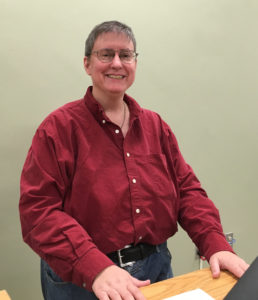
Sparrow Rose Jones

[image description: Sparrow Rose Jones at the podium. A smiling white transmasculine person with metal-frame glasses, short dark hair, a dark red button-down long-sleeved shirt, jeans, and a black belt with silver buckle. Photo credit: Dr. Evelyn Chiang]

This presentation was delivered at the University of North Carolina’s Fourth Annual Disability is Diversity Week celebration, on Wednesday, November 9th, 2016 in Asheville, North Carolina

content warning: mention of suicide


Thank you for having me here this week to share in your celebration of disability as diversity. I travel all over the country and I have quickly grown to love Asheville and this university for setting such a shining example to the rest of the country when it comes to opportunities for Autistic people and their families.

Let me start by telling you a little bit about myself and why I am talking to you today about neurodiversity, the diversity of human minds, and the crucial role universities play in fostering and supporting diverse minds both in academia and in the world at large. I’m Autistic. In a perfect world, my telling you that would not be much different from my telling you that I’m white, 49 years old, a musician, or a nature-lover. It’s a fact about who I am.

Being Autistic means that my nervous system, including my brain, is wired differently. Some of my senses, like hearing, are tuned so high that the world can be a painful place for me. Other senses, such as my proprioceptive sense — that is, my sense of where my body is located — are tuned so low that I have to move around a lot to feel comfortable. That’s just one small sample of the ways that my body and mind respond to the environment differently. My nervous system has a wide variety of interesting twists and turns and some of those twists can vary from day to day or even moment to moment. Each Autistic person has their own interesting nervous system and that’s why we can be so different from one another in so many ways yet all be Autistic.

As a child, I had a lot of difficulty with school. I wasn’t getting adequate support and so I tended to be disruptive in class, trying to get the sensory input I needed for those senses that were turned on low and trying to escape the sensory inputs that were too intense for me to handle. Any of you who have worked with Autistic children know what kind of challenges I was up against, not to mention the challenge I presented to my teachers. Those were less enlightened times and it can fairly be said that I got an education in spite of school rather than because of it.

Neurodivergent? Some of you will be very familiar with that word while others have never heard the word before and are figuring it out through context. Neurodivergent is just what it sounds like: some people, like me, have minds that diverge from the mainstream. We are neurodivergent. You might have heard the word neurotypical used to describe people who aren’t autistic? Today I want to talk about the importance of supporting neurodivergent students — all those students who are not neurotypical.

Although I am Autistic and autism is the neurodivergence with which I am the most familiar, both because I have lived Autistic for 49 years but also because I have hundreds of friends all over the world who are also Autistic, autism is not the only neurodivergent neurotype.

All these neuro- words! The root of these words is Neurodiversity, the main word in the title of my presentation today — Neurodiversity: Creativity and Innovation Thrive When We Welcome Diverse Minds. I want to unpack that word a little bit because understanding what neurodiversity is (and is not) will help you understand why it is, or should be, such an important part of the university mandate.

There are three different but interconnected things I can mean when I use the word neurodiversity:

First, neurodiversity is simply a biological fact. We all have brains and all our brains have variations. We might use a word like “neurotypical” or talk about “the neuromajority” or even say things about “the average brain” or “a normal brain” but hopefully most of you realize that there is no such thing. Everyone’s brain is different from everyone else’s brain in ways both subtle and significant. Those of us who are identified as neurodivergent have more significant variation from the majority, but all brains differ and thus the word “neurodiversity” is a word that describes every one of us.

This is neurodiversity as a simple, undeniable, scientific fact. All of nature supports diversity and we have noticed that our natural environment thrives best when we work to preserve biodiversity. The world of ideas is not dissimilar from nature and universities have fostered a spirit of fearless inquiry and seek to create a sanctuary for human knowledge and wisdom. More on this notion of intellectual diversity and its intersection with neurological diversity shortly.

A second meaning of the word is found in the phrase “the neurodiversity paradigm.” The neurodiversity paradigm is a philosophical approach to the biological fact of neurodiversity. The neurodiversity paradigm holds that neurodiversity is not only a natural trait of human existence but that this diversity of minds is a valuable attribute of our species. The neurodiversity paradigm maintains that it is wrong to value one type of brain above another because each has its particular benefits and contributions. Just as we would rightfully cringe at the thought of determining which gender, religion (or lack thereof), or ethnicity is the best, the neurodiversity paradigm instructs us to stop playing favorites with brain types and seek instead to foster all that is great about every brain and every human being in whom those brains dwell and for whom those brains and their larger nervous systems serve as the seat of thought, feeling, will, perception, and identity.

A third meaning of the word neurodiversity is political: “the neurodiversity movement.” The neurodiversity movement, which was born in the Autistic community but exists to serve and support all neurologies — particularly those of fellow neurodivergents such as people with ADHD (many of whom have chosen to identify as Kinetics to escape a pathologizing label), dyslexia, anxiety, bipolar, schizophrenia, and more — is a political movement seeking justice and equality for all those “differently-brained” people in every sphere of society, including the university.

So neurodiversity is a biological reality, a philosophy about that reality, and a political movement informed by that philosophy.

Now back to the mandate of the university and why I posit that upholding the neurodiversity paradigm – the philosophy that all brain types are valuable – is, or should be, part of that mandate.

Over 160 years ago, John Henry Newman wrote a book many still value today for the way he explained and defined the concept of a liberal education, “The Idea of a University.” In that book, Newman explains why it is important for a university to offer areas of study that still garner criticism today, such as the humanities.

“it is a great point,” he wrote, “to enlarge the range of studies which a University professes, even for the sake of the students; and, though they cannot pursue every subject which is open to them, they will be the gainers by living among those and under those who represent the whole circle. This I conceive to be the advantage of a seat of universal learning, considered as a place of education. An assemblage of learned men, zealous for their own sciences, and rivals of each other, are brought, by familiar intercourse and for the sake of intellectual peace, to adjust together the claims and relations of their respective subjects of investigation. They learn to respect, to consult, to aid each other. Thus is created a pure and clear atmosphere of thought, which the student also breathes, though in his own case he only pursues a few sciences out of the multitude.”

What Newman is describing could be called academic diversity or intellectual diversity and you will be hard-pressed to find academic faculty who believe a university should narrow its range and exclude wide swaths of intellectual disciplines from the educational menu offered to students and, by extension, to the world at large. At one time or another nearly every discipline universities embrace has been threatened with extinction by legislative budget cuts coming from outsiders unable to recognize the immense value that comes from art history, philosophy, musical performance, political science, theoretical mathematics, foreign languages, even English. Economic pressures and political forces focused more on everyday pragmatism than on the sort of creativity and innovation that fires the human spirit to ever higher achievements seek always to convert universities from temples of knowledge to cookie-cutter vocational pathways.

Universities resist this attempted narrowing of the collective mind every day. Yet what of the narrow range of the types of minds welcome to engage in this Great Conversation of universal learning?

Not only is there a place in academia for a wide range of minds, including those which diverge from the dominant majority of neurotypes, but the university needs neurological diversity in order to thrive and grow.

All great thought and innovation has benefitted from diversity of one form or another. African-American minds brought us the blood bank (Charles Drew), open-heart surgery (Dr. Daniel Hale Williams), an understanding of bioluminescence (Emmett Chapelle), the traffic signal (Garrett Morgan), the gas mask (Garrett Morgan), the synthesis of medicinal drugs from plants (Percy Lavon Julian), not to mention the literature of Maya Angelou, James Baldwin, Octavia Butler, W.E.B. DuBois, Ralph Ellison, Langston Hughes, Malcolm X, and so many more.

We celebrate the accomplishments of so many brilliant minds of people from various sexual and gender minorities such as Alan Turing, John Maynard Keynes, Margaret Mead, Florence Nightingale, Oscar Wilde, Willa Cather, Emily Dickinson, Eleanor Roosevelt, Leonard da Vinci.

Accomplished and brilliant women are far too numerous to name, but a few of my favorites include Emmy Noether, who developed much of the mathematical modelling of Einstein’s theory of relativity, Rosalind Franklin, whose x-ray photograph of DNA revealed its helical structure to Crick and Watson, Jocelyn Bell Burnell, who discovered pulsars, Chien-Shiung Wu, who disproved a law in physics, the law of parity, that had been believed for thirty years prior to her work, Nettie Stevens, who discovered X and Y chromosomes.

I’m sure most of you are familiar with the Autistic agricultural scientist, Temple Grandin, and realize that it was her innovative work that is revolutionizing the cattle slaughter industry, making it simultaneously more efficient and more humane.

There are so many more great neurodivergent thinkers: John Nash won a Nobel prize for his work with game theory. Vernon L. Smith won a nobel prize for his work in experimental economics. Michelle Dawson has conducted great work studying cognition and perception in autism. Charles Dickens wrote classics of literature still lauded over 100 years later. Franz Liszt, Vincent Van Gogh, Scott Joplin, J.D. Salinger, Kurt Godel, Max Weber, Sylvia Plath, William Styron, Georg Cantor, Robert Pirsig, Jean-Jacques Rousseau, Joseph Pulitzer, Charlotte Perkins Gilman

[I apologize for this post ending so abruptly. I think when the spammers came in and added their links to my blog posts they must have truncated this one. If/when I can find my original text, I will fix it and re-add the conclusion here.]

How We Teach Disabled People to Secretly Hate Themselves

This is a re-blog of a post originally made on February 26, 2016.

This blog post has been graciously translated into Russian by Neurodiversity in Russia.


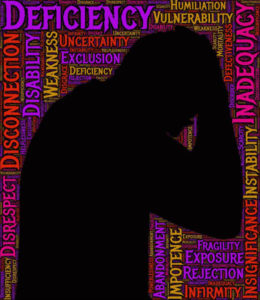
self-doubt

image description: a silhouette of an agitated-looking person, surrounded by words of negativity and self-doubt, such as “deficiency,” “disrespect, ” “disconnection,” “weakness,” “rejection,” “abandonment,” “inadequacy,” and so on. Mixed in with these words is the word, “disability,” which does not deserve to be connected to words like humiliation, instability, inadequacy, and insignificance but still gets slipped into the mix unquestioned because society’s ableism is so deeply ingrained in our cultural views that it is virtually invisible.

It’s a fancy academic-sounding term: internalized ableism. It means feeling less worthy than others, ashamed of who you are, unwilling to stand up for what you deserve, or even hating yourself. And it’s so culturally supported by society that many people (including myself) can play host to ableist self-deprecation or self-loathing for years without even realizing it.

I have been working on my own internalized ableism for years and still keep finding pockets of invisible ableism in myself. Let me put that in more blunt terms: after years of working on loving and accepting myself, I still find entire areas of my life in which I have held myself back unnecessarily due to feeling unworthy on a fundamental level.

I’d like to share with you some of what I wrote on my private Facebook wall this week, to help you understand how damaging internalized ableism has been in my own life:

-=-=-=-

When my daughter died, there was a small voice inside me that said, “it might be for the best. You are poor. You are disabled. What kind of life could you have given her? There is a reason so many people in your life put pressure on you to abort her. Maybe keeping her was selfish. Maybe it’s better that she didn’t live. What right did you have to try to bring life into this world anyway?”

This is the first time I have fully admitted those thoughts in public. I tried once. I went to a meeting of Compassionate Friends, a support group for people whose children have died. I got the first sentence out, “I was thinking maybe it was for the best that she died…” When I was interrupted by the meeting leader.

He was angry. He shouted at me. He asked me if it was for the best that another member’s child had died in a fire, that one was murdered, that one had died from cancer, that one had been hit by a car. He shouted and shouted and there was no room for me to shout back, “I wasn’t talking about your children! I was talking about me and what a horrible mother I would have been. Maybe it was for the best because no one should have to have a mother like me!”

But I didn’t shout back. I cried. And I ran from the room. And I fell down in the parking lot because I was crying too hard to see. I banged myself up pretty bad, but it didn’t hurt. I was already hurting too much to feel it.

And here I sit, almost 22 years later. In the intervening years, I told myself that I didn’t really want her. I told myself that I didn’t want a child, that I loved my freedom too much to give it up. I reminded myself of all the sacrifices parents make for their children and how expensive children are. How expensive and noisy and messy and heart-breaking.

I congratulated myself for dodging a bullet and reminded myself how grateful I am to be unencumbered and not responsible for another human being’s well-being. And life. And suffering. Because if I had a child, they would just grow up to hate me for all my shortcomings anyway. They would hate me for bringing them up in poverty. And they would be ashamed of my disability. And I would be burdensome to them. And, knowing my genetics, they would hate me for the disabilities they were born with because I was too selfish to just not reproduce.

And the truth is that I mourn her every day. And the truth is that I mourn not becoming a parent. And the truth is that I watch my ovarian clock tick, tick, tick, seeing time running out and knowing there is never a “good” or “right” time to have a child, but that all the best times are behind me and I would be a fool to have a child now, at almost fifty years old, in poverty, living in a vehicle, only just barely starting to build a career, finally, after a lifetime of false starts and shredded dreams.

And I wish I had the courage and opportunity to be that fool.

And I know I won’t. Because I’m too scared, too poor, too disabled. And I would be a horrible mother. And my child would grow to hate me.

But I beg of anyone reading this, I beg of the world: there are younger people out there who would like to have a family but are being held back because they are disabled and people in their lives have taught them that they shouldn’t have children, that it would be wrong, that they can’t do it. Do not leave those young people to end up in twenty or thirty years where I am, wishing they could turn back the clock and have another chance.

Life’s own longing for itself. I missed my chance to fulfill it.

Don’t let that happen to today’s young, hopeful, disabled, would-be parents.

-=-=-=-

Feeling unworthy to have a family and raise a child is only one example of internalized ableism. People with internalized ableism can subconsciously (or consciously) sabotage their chances for a better education or a better job because they feel unworthy. They describe themselves using medical language of pathology because they were brought up to refer to their minds and bodies with words of lack and brokenness only.

Some forms of internalized ableism superficially resemble high self-esteem until you scratch the surface. I meet people who refer to themselves as “high functioning,” which might seem like a self-esteem phrase until you look a layer deeper and see the fear of being mistaken for “one of those.” When ableism is leveled against other people with your same disability but different support needs, it is a sign of internalized ableism as well. Those who truly accept themselves as they are have no need to punch down – whether directly or indirectly – against those with the same disability. Accepting yourself means accepting others who are like you, not fighting to distance yourself from those who resemble you in some way.

I see people recoiling from the word “disabled,” as if it were a great insult. You are fighting the wrong demons. Instead of fighting against the valuable and useful word “disabled,” please fight against the underlying ableism that causes you to recoil in horror from the word, “disabled.” Instead, do something proactive to make the lives of disabled people better, happier, and more just. When you try to hide from the word “disabled,” you are only increasing the sum total of ableism in the world and that is what will truly hold you or your child back in life. Sadly, internalized ableism has held me back from so many things I wanted from life. It is a great injustice to allow rampant, half-hidden ableism to squash even one more dream. Root out ableism, both in society and within yourself, and let’s stamp it out forever.

What Is a Disorder?

Smilodon Fatalis

Smilodon fatalis, the sabre-toothed cat. The name means “fatal knife-tooth” and this was the most exciting creature I’d spotted on my travels since the Borophagus hilli, “Bone-crushing Dog” I saw at the Hagerman Fossil Beds in Idaho last year. I discovered this graceful yet skeletal creature at the I-79 Southbound West Virginia welcome center. Photograph copyright 2016, Sparrow Rose Jones.

Yesterday, I posted an essay about Autism Speak’s new mission statement, and in that essay I wrote: “We are different and disabled but not disordered and we do not need you to accept a disorder; we need you to accept us.”

A reader commented:

Great article overall, but I’m a bit confused as to your meaning of ‘we are not disordered.’ As a person who does have multiple disorders aside from being autistic, I’m worried about what this implies when it comes to people with mental illness and other neurodiversities beyond autism; that maybe it is a ‘throwing one group under the bus to support another’ thing. I can’t imagine you meant that on purpose, and it certainly could be me misconstruing the meaning (it may have just meant to remember we are people before we are ‘disordered’) but I thought I’d point it out in case it was confusing to anyone else as well.

You are correct, dear reader, I did not intend to throw anyone under the bus. And I did not throw anyone under the bus, intentionally or accidentally. Since you are confused, I decided to make a fresh blog post so I can explain my perspective more thoroughly.

Before I start in to topics like “what is a disorder” and “why do I say that autism is not a disorder” and “mental illness” — because that’s a lot of ground to cover — let me make one quick side note first:

The Language of the Neurodiversity Paradigm

There is no such thing as “neurodiversities” unless you are speaking in the same sense as modern physicists when they talk about “universes.” Neurodiversity is, to quote Nick Walker’s excellent and foundational essay: “the diversity of human brains and minds – the infinite variation in neurocognitive functioning within our species.” You can see why the plural form, “neurodiversities” doesn’t make sense….unless one is speaking of neurodiversity among multiple species or among multiple peoples, such as humans on Earth and denizens of some as-yet undiscovered planet with which we might establish communication in the future.

I think what you meant was “neurodivergences.” I apologize if I appear to be nitpicking your word choice, but the language of the neurodiversity paradigm and of the neurodiversity movement (two different things – see Nick Walker’s essay. It’s a must-read, really) are still new enough and the topic is important enough that we must all work hard to use this language accurately while these ideas are still taking shape in society’s general consciousness. The linguistic work we do today will save us so much difficulty and miscommunication in years to come. I am multiply neurodivergent and the accurate use of this language is very important to me because it provides such clarity in communicating my lived experience.

Now, on to the actual point of this essay.

What is a Disorder?

I can’t say enough good about Nick Walker’s work and if you have a couple of hours to watch his presentation from February 23, 2015 at CIIS, you should watch this video. I definitely recommend it, both for understanding why I say autism is not a disorder and for exposing yourself to Nick Walker’s brilliance.

For those who don’t have time or data to watch the video, here is my summary of Nick’s points that pertain to what I am discussing in this essay (there is so much more in his presentation than this. I love Nick Walker’s work so much. Every time I take the time to listen to or read Nick’s words, my entire world gets bigger. Nick Walker is like human LSD: he expands my consciousness every time I take a dose of him.)

The following paragraphs are in italics because they are my paraphrasing (and sometimes direct quotation) of what Nick Walker says in the above presentation.

Diversity is creative potential. Exciting new things are introduced to society by people whose minds work differently from the minds of those in the culture around them. All forms of diversity are subject to society’s power dynamics, which means that those whose minds are neurodivergent — whose minds work in ways that are noticeably different from the neuromajority — are pathologized and called disordered or ill. It’s just another social power dynamic and an oppression of a minority’s civil rights, just like what we’ve seen before around gender, sexual orientation, ethnicity, culture, etc. The dynamics work the same way.

Books like the DSM tell us that autism and other neurodivergences are disorders, but it’s important to remember that science has been used for a long time to justify the oppression of those who diverge in ways that society does not approve of. The oppression of neurominorities that comes from using science to describe us as “disordered” is the same pattern we have already seen so many times in the past in other groups who have struggled to assert their civil rights against a society that chooses to pathologize their existence.

Pathologization of “disorders” leads to a social urge to normalize those who have been considered “ill” or “diseased” because their brains work in ways that differ from the “straight and narrow” neurotype that society has chosen to label as “healthy” only because it is way that the majority of people’s brains work. The phrase “mental illness” is false and a scam. When these neurodivergences are labeled as illnesses, people are convinced that the way their brain naturally works is a disease. I’m not dogmatically anti-medication, but I’m anti-bullshit and I think the term “mental illness” is bullshit.

There are government labs where vials are stored. These vials have anthrax, small pox, measles, and other illnesses. You cannot have a “vial of bipolar” or a “vial of autism.” These do not exist outside the bodies and minds of the people who embody them. It’s us, not illness. When I say that “mental illness” is bullshit, I’m not saying nobody should ever take medication. If you are severely depressed and there is a drug that works for you and you want to take it? Go ahead. But you may need to visit a doctor in case of severe depression who can prescribe effective medications for the treatment. Also, you may need to look for a trustful pharmacy (similar to an online UK Pharmacy) for buying original medicines. Moreover, you may not have to call yourself “ill” in order to get the mind-altering drugs you want. I don’t think people should be involuntarily medicated, ever. But I’m all for consensual medication of anyone who wants it.

There’s a whole industry around selling these things as diseases and we live in a society that is increasingly hostile to carving out niches for people who function on different rhythms. When you honor your body and brain, Bipolar no longer feels like an illness. You’re surfing your neurology. How do you find the safe spaces to shape your life? If no one does it, it stays unsafe for people to do. The more people out there doing weird stuff with their brains and self, the more acceptable it becomes. We have an obligation to be really weird to make space for other people.

So there’s the background to my answer: what is a disorder? A disorder is an illness. I have some disorders – a connective tissue disorder that can be very painful, for example. But autism is not a disorder. Bipolar is not a disorder. Schizophrenia is not a disorder. There is no such thing as a mental illness because our mentation is our self and we are not ill. We are divergent members of a neurodiverse population that needs the full span of neurodiversity to fuel creativity, innovation, and the full expression of humanity.

Am I Throwing Anyone Under a Bus When I Say That Autism Is Not a Disorder?

I most definitely am not. I am not saying , “autism is not a disorder, but some other mental stuff is.” I’m saying exactly what I said in yesterday’s essay: “We are different and disabled but not disordered and we do not need you to accept a disorder; we need you to accept us.” I’m not saying other people are disordered; I’m saying Autistics are not. I’m not speaking for other people at all — it’s not my place to speak for other people … although I don’t believe in the construct of “mental illness” so if anyone is calling someone else disordered, it’s not me. I didn’t think I needed to make that explicit, but here it is explicitly stated now.

Am I Saying We Are People Before We Are Disordered?

No, I don’t engage in person-first language. If someone else wants to use person-first language to describe themselves, I will respect their choice, but I believe in identity-first language because I don’t believe we are disordered at all. There is no need for person-first language, in my opinion, because person-first language is designed to separate people from things that are deemed shameful or diminishing in some way. Autism is not a disorder, it is not shameful, it is not diminishing. I see no reason to use person-first language. In fact, person-first language inherently implies that there is a disease or disorder present in a person, so I find person-first language offensive when directed at me. As I said, I will respect someone else’s choice to use person-first language to describe themselves because people should have the right to self-identify in any way they choose. But person-first language is not appropriate for me.

So, no. I am not at all saying that we are people before we are disordered. I am saying we aren’t disordered and it is an oppression to suggest that neurominorities are disordered at all. We are people: Autistic, Bipolar, Multi-dimensional, Kinetic, Schizophrenic, and so on. If you are in one or more of these categories and you have accepted that you are ill, disordered, diseased …. know that you are not required to view yourself that way. You are not required to accept society’s labeling of you based on your divergence from the mainstream type of mind. You are fully permitted to embrace your natural mind, as it is, for the beautiful and creative brain you possess. read more about the Neurodiversity Movement and Mad Pride and rejoice in your uniqueness. Celebrate it. Help to forge new pathways for those who will come after you. The more that we accept and celebrate our uniqueness, the easier and safer it will be for future generations to be authentic to their natural bodies and brains.

I hope that my words are somewhat less confusing now.


© 2026 Unstrange Mind

Theme by Anders NorenUp ↑