The powers-that-be love to frame autism and Autistic people as problems to solve. Puzzle pieces, if you will.
When I saw this incredibly powerful Tweet (what do we call Tweets now? Xes?) by Bishop Talbert Swan, I knew I needed to add my Autistic voice, highlighting transgressions against Disabled people:
Image description and transcription of Bishop Swan’s post:
Top image: a circular photo of Bishop Swan: a Black person with dark sunglasses and a beard, next to the words “Bishop Talbert Swan” and “@TalbertSwan”
A former Fox News host, who paid a settlement to avoid a sexual assault case, is Secretary of the Department of Defense.
The former head of World Wrestling Entertainment, who is accused of covering up the sexual abuse of minors, is over the Department of Education.
A former heroin addict, who is accused of sexual assault by a former family babysitter, is over the Department of Health & Human Services.
A 34 time convicted felon and adjudicated rapist, who has been accused of sexual assault by 26 women, is president of the United States.
When unqualified, morally bereft, white people occupy the highest positions in our government, y’all need to shut up about Black people and DEI.
Autism & Disability: When Power Talks About Us Like We’re a Problem
In another briefing, he claims autistic people “will never play baseball, date, pay taxes or have a job”, erasing millions of Autistic children and adults, at all levels of support needs, who do exactly those things. More importantly, this narrative teaches the people to think of human value in terms of productivity, that is to say, the narrative devalues all human life by declaring that people who can’t work have no intrinsic value.
The same administration created a presidential health commission and boasted that “by September, we will know what has caused the autism epidemic and we will be able to eliminate those exposures”. It was a promise disability advocates called impossible, misleading, and ableist.
While top officials portray Autistic people as tragedies, burdens, or people with no future, their Education Department is busy rolling back protections: rescinding 72 guidance documents that spelled out the rights of disabled students under federal law.
Successive Education Secretaries push voucher and “school choice” schemes that often require parents of disabled kids to sign away their IDEA rights (rights to an appropriate education, services, and due process) if they want to leave underfunded public schools.
At the same time, the Justice Department removes multiple ADA guidance documents from its website: materials that helped businesses understand their obligations to disabled people. The DoJ called them “unnecessary and outdated,” even as advocates warn this weakens enforcement.
Across federal agencies, DEI offices and resources, including those meant to help marginalized and disabled people access education and jobs, are dismantled or wiped from websites after a White House order attacking DEI.
Image description: A large natural stone arch spans between two rocky cliffs in Virginia. The arch is made of gray and tan limestone, with green trees growing along the top and on both sides. The view through the opening shows a bright, cloudy sky surrounded by dense forest.
The Child No One Wanted in Class
A recent New York Times article (October 1, 2025) suggesting autism needs to be broken into two categories cited “a survey of 800 families, conducted this year by the National Council on Severe Autism, [which] found that 80 percent had been told their children were too disruptive even for classrooms and services tailored to students with autism and other disabilities.”
While no one would accuse me of having “severe autism,” I, too, was an unwanted, disruptive presence in my classrooms. My kindergarten teacher loved me, even though I bit her when she tried to pull me out from under the table where I was hiding. My first grade teacher hated me and requested I be removed from her classroom and put in special education. She called me the R-word.
When I think back on elementary school, it’s hard to remember what happened, where. I changed schools so many times I’d been in at least six different schools by fourth grade. Sometimes there were other reasons for shuffling me around, but I was removed from many classrooms because teachers couldn’t handle me. No one knew what to do with me.
I’d slither on the floor like a lizard. I’d meow like a cat. I’d take any opportunity to hide under a table where it was darker, quieter, less overwhelming. My emotions erupted straight through my skin with no regulator, no buffer. My outbursts and disruptions became louder and more appalling the older I got. By middle school, I’d gotten myself expelled from the entire county school system. There was no place back then for someone who was both academically gifted and behaviorally disabled.
They have a word for it now: twice exceptional.
I hope they have more than a word.
I hope kids like me actually have a place now.
A Spectrum With No Middle
I grew up to find “my people”… sort of. Maybe.
There’s a current cultural argument: autism should be split into “profound” and “non-profound” autism. Researchers have joined the debate, studying where to draw the line and how to justify it. Quoted in the Times article, Ari Ne’eman, long-time Autistic self-advocate, compared the attempt at separating autism into two camps to trying to “cleave a meatloaf at the joints.”
I don’t belong on either side. Will that cleaver chop me in two?
My life keeps proving what the research hints at: the middle of the spectrum is where services, language, and understanding fall apart.
Services for “profound autism” will not help me. I speak, I write, I drive. I don’t require 24/7 supervision. I remember the days when those services were the only thing there was. I was drowning in my own life and no one would help me because my IQ is higher than 70. These are services only available to people who can’t ask for them.
But support and services for “non-profound autism” leave me behind, too. I have a hair-trigger nervous system. I become “profoundly” dysregulated and cannot “behave appropriately” in systems where no one is trained on the nuclear level meltdowns that overtake my bodymind in times of intense stress. My sensory sensitivities are calibrated so finely that I can barely stand to be around people (despite being an extrovert who loves human connection.)
I belong to the messy middle. We fall through the cracks.
The Lived Middle
When I read about the proposed split, profound vs. non-profound, I can see what each side is trying to describe, but (like many Autists…most Autists?) I live in the space between them. I don’t need someone to monitor my every move for my safety. But I do need someone who understands that my nervous system runs like a live wire, and that a “simple” social misunderstanding or a flickering fluorescent light can send me spiraling into hours of recovery.
I can cook, drive, write, edit, and facilitate groups. I can also lose the ability to speak for days. I can manage complex projects for work, then fall apart because someone touched me in the grocery store. When I melt down, my brain doesn’t politely announce, “please excuse the emotional disturbance.” It shuts down my access to my prefrontal cortex (while leaving my brain’s language center dismayingly untouched!) and throws me into a physical storm that feels like experiencing every threatening emotion in one giant tsunami.
I am neither the non-speaking child in a residential facility nor the worker who has kept the same job for twelve years (though not, I should note, without suffering or struggle). I am the missing middle case: the one who gets lost when systems are built for either the child who can’t communicate or the adult who can network.
If autism is divided, where will people like me go? “Profound” autism categories will not include me because I can speak. “Non-profound” services will exclude me because I cannot perform neurotypicality sufficiently to keep a job more than a few months. When I am regulated, I can explain my meltdown with elegant clarity; when I am in it, all I can do is scream obscenities. This same body holds both truths.
The danger of the cleaver isn’t just that it divides. It crushes the connective tissue. We mid-gradient people prove that autism isn’t a tidy collection of buckets but a terrain of overlapping ranges. We are the fault lines that make the whole visible.
The Scientific Lens, the Polygenic Divides
A 2025 study in Nature Medicine put forth the thesis that autism looks different depending on when someone is diagnosed. Researchers tracked thousands of children and found two main developmental arcs: one that emerges early, and one that surfaces later. The early group, usually diagnosed around preschool age, showed strong signs of dysregulation and social difference from the start. The later group, those not diagnosed until adolescence or adulthood, looked more “typical” in early childhood, then began to struggle as social life grew more complex.
Genetically, those two arcs map onto different constellations of traits. The early group is tied to genes that influence social communication and sensory processing. The later group is tied to genes overlapping with ADHD, PTSD, and depression. According to the data, the two profiles are distinct enough that they could almost be seen as different “autisms.” Yet even the researchers left an undefined window between ages six and nine, a no man’s land where neither trajectory cleanly applies.
I land in that overlap zone. I have an early-identified nervous system carrying the later-diagnosed cluster of comorbidities. My life is where the two curves meet and tangle. I was initially diagnosed at seven (squarely between “early” and “late,” in the study’s framework) yet I live with both the extreme emotional dysregulation the study defined as a hallmark of early diagnosis and the ADHD, PTSD, and chronic struggle with anxiety and depression that the study found more common among later-diagnosed people. I’ve always been the statistical noise that refuses to average out.
The scientists used the word polygenic to describe how hundreds of genes combine to shape each person’s developmental path. I think of it as poly-everything: polytraumatic, polysensory, polymodal. I’m a multivariate outlier. My neurology carries multiple histories at once: genetic, experiential, cultural. I am early-emergent in my meltdown profile, late-emergent in my self-awareness, and forever trying to reconcile a body that feels ancient with a mind that keeps discovering itself anew.
When researchers talk about these two genetic “factors,” they still speak as though everyone fits neatly into one or the other. But so many of us are hybrid systems: early storms that never quieted, layered with late revelations. The data call me interstitial. I call it being alive at the seam where categories unravel.
Science likes to sort, but the closer researchers look, the more the borders blur. Each new study meant to clarify autism’s architecture ends up revealing new subtypes, new overlaps, new contradictions. Attempts to cage the spectrum only unravel into a cluster of intersecting constellations. Advocates of the “profound autism” label say there is not one autism. In truth, there are not two autisms, either. There are many autisms, coexisting and often colliding in combinations inside a single person. The data are only beginning to catch up to what many of us have lived all along: there is no single arc, no single story, no single way to be Autistic. It’s Ari’s meatloaf with traits thoroughly mixed throughout, not lined up as discrete slices.
An Ethical Gap: Diagnosis Without Disclosure
I was diagnosed at seven but first told at thirty-four. For twenty-seven years, I lived with the label but not the knowledge. The word autism lived in files, not in my awareness. Others had access to information that could have helped me make sense of my life, but no one handed me the map.
When researchers talk about age of diagnosis, they assume the person diagnosed actually knows. But there’s another trajectory that rarely enters the data: early-diagnosed on paper, late-diagnosed in life. On a chart, I’d be plotted among the “early” cases; in lived time, I belong with the “late.” With my mixed collection of traits, I belong nowhere.
That’s one ethical vacuum in the whole conversation about splitting autism into “profound” and “non-profound.” What good are new categories if the people inside them still aren’t told who they are? The system can label a child, publish the data, even claim early intervention success — but if that same child grows up without language for their own difference, what intervention was that, really?
Diagnosis ≠ disclosure ≠ support.
Knowing about me is not the same as letting me know myself.
The Human Cost of Polarization
Both sides of the split debate are reacting to genuine pain. The parents of children with high support needs see the more verbal Autists growing in numbers, eclipsing children like theirs, putting forth an ideology that they fear will leave their children behind. They’re fighting neglect in a world that offers little safety net, little respite, and too few clinicians willing to take on complex cases.
Neurodiversity activists, on the other hand, are fighting erasure. For years they were told they weren’t “really” Autistic, that they were just eccentric or socially awkward. Meanwhile, glossy “Autism Awareness” campaigns featuring celebrities peddle a narrative of tragedy, comparing autism to diabetes and cancer.
But between those two righteous causes lies a widening gulf that swallows anyone whose life defies both archetypes. When advocacy polarizes around who suffers “enough” to be considered truly Autistic, people like me flounder with few places to turn for useful help.
I was the child too disruptive for classrooms and too verbal for compassion. I lost school placements not because I couldn’t learn, but because no one knew how to teach someone like me. I carried untreated trauma for decades because professionals saw only defiance, not distress. Even now, the daily work of emotional regulation: holding myself together through noise, touch, light, and human unpredictability? It’s invisible labor few realize I’m slogging through every day. I don’t fit either narrative. I suspect most Autists don’t. Who is researching that?
For the “profound” camp, I’m too capable. For many in the “neurodiversity” camp, I’m too volatile. But my existence proves both realities true at once: the need for safety and care, and the right to self-definition. The binary breaks apart where I live.
My Life as a Bridge
When I call myself a bridge, I mean the structure, the connective tissue that holds two sides in relation. The middle is not an absence but an architecture. People like me show where the spectrum’s supposed endpoints bend toward each other.
My neurology is hybrid, not broken. It offers a way to see autism as an ecosystem rather than a spectrum line. Forests don’t divide cleanly into “trees” and “not trees.” They contain gradations of shade and soil, roots interlaced underground. Autism is like that: an ecology of traits and bodies that shape one another. To understand the whole, you have to study the overlap zones, the places where categories blur and organisms coexist.
If research and policy treated those overlaps as instructive instead of inconvenient, support could become scalable and individualized rather than categorical. A system built for complexity would ask different questions: not “Which kind are you?” but “What do you need, and what helps you thrive?”
This is an ethics of care that designs for the edges and intersections, not the average case. The bridge perspective doesn’t erase difference; it honors it by keeping the structure intact for everyone who lives between.
Reclaiming the Middle Ground
I think of that child on the classroom floor, hiding under a table because it was the only place that felt safe. The lights were too bright, the noise too sharp, the air thick with other people’s expectations. No one knew what to do with that child. The teachers wanted them gone. The files called them disruptive. But they were trying, in the only language they had, to build a bridge between their bodymind and the world.
What if the field saw that child not as an outlier, but as the center? What if the messy middle was understood as the heart of autism rather than relegated to its margins? Every diagnosis, every theory, every classroom could start from that question: what happens when we design for the ones who don’t fit cleanly anywhere?
What if we center them in the story of their own life?
The future of autism can’t belong to the extremes alone. It belongs to us all: to those clearly defined and to those who live in the thresholds, translating between worlds, proving that connection itself is a form of intelligence. The spectrum’s strength has always been its range, and its hope lies in those who refuse to disappear into binaries.
That child is still here, learning to stand in the open. The world is finally beginning to meet them halfway.
Zhang, X., Grove, J., Gu, Y., Buus, C. K., Nielsen, L. K., et al. (2025). Polygenic and developmental profiles of autism differ by age at diagnosis. Nature Medicine, 31(2), 225–238. https://doi.org/10.1038/s41586-025-09542-6
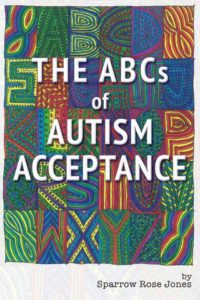
This post originally appeared on April 1, 2015. The book that resulted from this Autism Acceptance Month project, The ABCs of Autism Acceptance, is available from Autonomous Press.
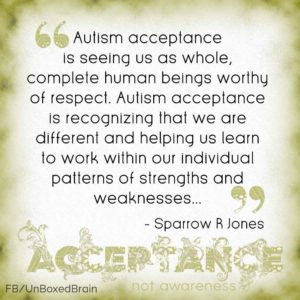
[image description: A quote card, white with olive green highlights. It says “Autism acceptance is seeing us as whole, complete human beings worthy of respect. Autism acceptance is recognizing that we are different and helping us learn to work within our individual patterns of strengths and weaknesses…” – Sparrow R. Jones. Beneath the quote is the word ACCEPTANCE in all capital letters, an ornate font, and olive green. The bottom left corner of the image says FB/UnBoxedBrain, indicating the facebook page of the creator of the quote card.]
A is for Acceptance
You may have noticed in the last half-decade or so that there is a growing trend toward speaking of autism acceptance instead of autism awareness. By now, most of you probably know why people are making that choice, but just yesterday I saw a lot of people arguing about the topic, so I think we still need to make it clear.
Autism awareness, in and of itself, is not inherently bad. By now, most people are aware that there is a thing called autism but, in my experience, most people are not very aware of what that autism thing actually is. So I do, at least partially, agree with the people who say we still need more awareness.
What I have a problem with is the form that awareness tends to take.
A week ago, I had to stop listening to the radio because all the stations were already gearing up for April with lots of “awareness” and lots of advertisements about awareness events. I heard a lot about children with autism and nothing at all about Autistic adults. Not only do we “age out” of most services when we turn 18, but we also become invisible. It’s as if the entire world stops caring about us once we are no longer cute children to worry about and, instead, inconvenient adults to be stuck with.
I heard a lot of scare talk, including hearing us repeatedly compared to diabetes, cancer and AIDS. Diabetes, cancer and AIDS kill children. Autism does not. Diabetes, cancer and AIDS are illnesses laid on top of a child’s underlying identity – they can change a child’s philosophy but they do not change innate aspects of their identity. Autism is a cognitive and perceptual difference that is so deeply rooted in our neurology that it cannot be separated from our identity. Beneath cancer, there is a healthy child hoping to break free. Beneath autism, there is more autism – it’s autism all the way to the core. Autistic children do not “go into remission,” they develop coping skills and they mature into Autistic adults, and they work to learn ways to communicate with those around them. There might be suffering that can be alleviated – seizures brought under control, gastrointestinal disorders treated, methods learned and sometimes medications taken for mitigating anxiety. Autistic adults often do not resemble the Autistic children they once were – we grow and develop all our lives – but Autistic adults are still every bit as Autistic as they were when they were children, no matter how many coping skills are learned, no matter how “indistinguishable from their peers” they become.
At the center of the autism awareness movement is an organization known as Autism Speaks that functions like a giant magnet, drawing all donations to them. In the ten years that Autism Speaks has been around, local organizations have watched their funding dry up. Autism Speaks dominates the autism charity scene now and, as a result, they have the power to set the tone when it comes to “awareness.” And that tone is one of despair and misery. We are portrayed as burdens who break up marriages and destroy the lives of those around us. We have been compared to “lepers” (an outdated term for people with Hansen’s disease) and our parents to saints for taking care of us. The awareness that is being put forth is shaped around a rhetoric of fear. Autism Speaks is one of the few organizations that is widely hated by the population it was established to serve. Only one Autistic person was ever accepted in a leadership role and he resigned, saying, “No one says the Cancer Society does not speak for them. No one describes the Cystic Fibrosis Foundation as an evil organization. All that and more is said of Autism Speaks every day. I’ve tried to be a voice of moderation but it hasn’t worked. Too many of the views expressed by the organization are not my own; indeed I hold very different points of view.”
So that is autism awareness. That is what we are rejecting.
What is autism acceptance? Autism acceptance is seeing us as whole, complete human beings worthy of respect. Autism acceptance is recognizing that we are different and helping us learn to work within our individual patterns of strengths and weaknesses to become the best people we can be, not trying to transform us into someone we are not. Autism acceptance is remembering always that Autistic people are listening, including those who might appear not to be, and choosing to speak of autism and Autistic people in ways that presume competence and communicate value.
“Tolerance says, “Well, I have to put up with you.” Awareness says, “I know you have a problem and are working earnestly to fix it.” Acceptance says, “You are amazing because you are you, and not despite your differences, but because of them.”” – Kassiane Sibley
“Acceptance is about recognizing that an autistic person is, and will always be, different but not less – even as some challenges are addressed. ” – Amy Sequenzia
“Autistic people are not viewed as able beings, this view makes us suffer.” – Emma Zurcher-Long
“Autism Acceptance means supporting the Autistic person in learning the things they want to learn and in gaining the skills they need for what they want to do. Autism Acceptance is the radical assertion that at the level of broad, overarching principles, what Autistic people need isn’t that different. We need to be accepted for who we are. We need to hear that we’re OK, we need to hear that the things we have trouble with don’t make us broken or lazy or horrible people. We need people’s actions towards us to reflect that. We need people to listen when we say we need help, and we need people to listen when we say we don’t. We need to be taken as the whole people that we are, and we need to be met with the understanding that we are the experts in our own lives and abilities.” – Alyssa
“Good teaching is based in deep respect for the individual, the cognitive learning style of each student, the shared excitement about the topic of study. Best practice in teaching autistic students isn’t any different, though these faculty would be insulted if I told them so.” – Carolyn Ogburn
“Over the past two years, I have asked Tyler many times how he feels about having autism. And while he clearly understands how the autism negatively affects his social skills and attention, he always tells me that he likes his autism. Although he has also told me, at times, that he wants to be “normal,” he continues to insist that his autism helps him. So if he likes his autism, do I really have the right to counsel him otherwise?” – Kymberly Grosso
“If you have the autism acceptance song in your heart, add Paula and Estée’s voices to your blog rolls, Subscribe to their blogs. Tweet, ‘like’, and show your respect and support to these powerful women. Don’t allow their names to fade into internet oblivion as others try to opt into autism acceptance because it is now the fashion. They were doing it before it was cool. It is easier to say accept autism now because others paid the high cost for daring to say it before us.” – Kerima Çevik
“Acceptance means accepting yourself as you are, even in the face of persistent attempts throughout your life to get you to be what you are not. Especially in the face of persistent attempts throughout your life to get you to be what you are not. The best you can be is Autistic. Let me explain. “The best you can be is Autistic” means that you are at your best when you are being fully who you are, able to express yourself and move through the world in ways that are right for you, comfortable for your body. “The best you can be is Autistic” does not imply impairments, “less than,” “can only do so much.” On the contrary, it means that you are who you are- your pervasive Autistic self (which actually includes those parts that observers might think are “typical” just because they can’t see anything that looks unusual to them), and that encompasses all of who you are, not just the parts that have been “permitted,” and not just the stuff that whatever the DSM of the moment says are your deficits.
“You have the right, or should, to grow in ways that are good for you, that you think are good for you. You have the right to make changes in your life that you think are the correct ones for you.” – Paula C. Durbin-Westby, founder of Autism Acceptance Day/Month/Year/Decade
[image description: a full-color image of the book cover of The ABCs of Autism Acceptance by Sparrow Rose Jones. The cover features a semi-abstract drawing of the alphabet done in rainbow colors and a doodle style of drawing. Copyright 2016, Sparrow Rose Jones and Autonomous Press.]
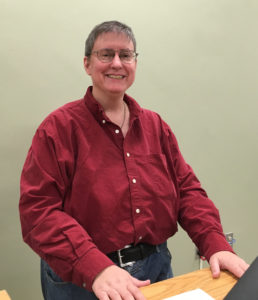
[image description: Sparrow Rose Jones at the podium. A smiling white transmasculine person with metal-frame glasses, short dark hair, a dark red button-down long-sleeved shirt, jeans, and a black belt with silver buckle. Photo credit: Dr. Evelyn Chiang]
This presentation was delivered at the University of North Carolina’s Fourth Annual Disability is Diversity Week celebration, on Wednesday, November 9th, 2016 in Asheville, North Carolina
content warning: mention of suicide
Thank you for having me here this week to share in your celebration of disability as diversity. I travel all over the country and I have quickly grown to love Asheville and this university for setting such a shining example to the rest of the country when it comes to opportunities for Autistic people and their families.
Let me start by telling you a little bit about myself and why I am talking to you today about neurodiversity, the diversity of human minds, and the crucial role universities play in fostering and supporting diverse minds both in academia and in the world at large. I’m Autistic. In a perfect world, my telling you that would not be much different from my telling you that I’m white, 49 years old, a musician, or a nature-lover. It’s a fact about who I am.
Being Autistic means that my nervous system, including my brain, is wired differently. Some of my senses, like hearing, are tuned so high that the world can be a painful place for me. Other senses, such as my proprioceptive sense — that is, my sense of where my body is located — are tuned so low that I have to move around a lot to feel comfortable. That’s just one small sample of the ways that my body and mind respond to the environment differently. My nervous system has a wide variety of interesting twists and turns and some of those twists can vary from day to day or even moment to moment. Each Autistic person has their own interesting nervous system and that’s why we can be so different from one another in so many ways yet all be Autistic.
As a child, I had a lot of difficulty with school. I wasn’t getting adequate support and so I tended to be disruptive in class, trying to get the sensory input I needed for those senses that were turned on low and trying to escape the sensory inputs that were too intense for me to handle. Any of you who have worked with Autistic children know what kind of challenges I was up against, not to mention the challenge I presented to my teachers. Those were less enlightened times and it can fairly be said that I got an education in spite of school rather than because of it.
Neurodivergent? Some of you will be very familiar with that word while others have never heard the word before and are figuring it out through context. Neurodivergent is just what it sounds like: some people, like me, have minds that diverge from the mainstream. We are neurodivergent. You might have heard the word neurotypical used to describe people who aren’t autistic? Today I want to talk about the importance of supporting neurodivergent students — all those students who are not neurotypical.
Although I am Autistic and autism is the neurodivergence with which I am the most familiar, both because I have lived Autistic for 49 years but also because I have hundreds of friends all over the world who are also Autistic, autism is not the only neurodivergent neurotype.
All these neuro- words! The root of these words is Neurodiversity, the main word in the title of my presentation today — Neurodiversity: Creativity and Innovation Thrive When We Welcome Diverse Minds. I want to unpack that word a little bit because understanding what neurodiversity is (and is not) will help you understand why it is, or should be, such an important part of the university mandate.
There are three different but interconnected things I can mean when I use the word neurodiversity:
First, neurodiversity is simply a biological fact. We all have brains and all our brains have variations. We might use a word like “neurotypical” or talk about “the neuromajority” or even say things about “the average brain” or “a normal brain” but hopefully most of you realize that there is no such thing. Everyone’s brain is different from everyone else’s brain in ways both subtle and significant. Those of us who are identified as neurodivergent have more significant variation from the majority, but all brains differ and thus the word “neurodiversity” is a word that describes every one of us.
This is neurodiversity as a simple, undeniable, scientific fact. All of nature supports diversity and we have noticed that our natural environment thrives best when we work to preserve biodiversity. The world of ideas is not dissimilar from nature and universities have fostered a spirit of fearless inquiry and seek to create a sanctuary for human knowledge and wisdom. More on this notion of intellectual diversity and its intersection with neurological diversity shortly.
A second meaning of the word is found in the phrase “the neurodiversity paradigm.” The neurodiversity paradigm is a philosophical approach to the biological fact of neurodiversity. The neurodiversity paradigm holds that neurodiversity is not only a natural trait of human existence but that this diversity of minds is a valuable attribute of our species. The neurodiversity paradigm maintains that it is wrong to value one type of brain above another because each has its particular benefits and contributions. Just as we would rightfully cringe at the thought of determining which gender, religion (or lack thereof), or ethnicity is the best, the neurodiversity paradigm instructs us to stop playing favorites with brain types and seek instead to foster all that is great about every brain and every human being in whom those brains dwell and for whom those brains and their larger nervous systems serve as the seat of thought, feeling, will, perception, and identity.
A third meaning of the word neurodiversity is political: “the neurodiversity movement.” The neurodiversity movement, which was born in the Autistic community but exists to serve and support all neurologies — particularly those of fellow neurodivergents such as people with ADHD (many of whom have chosen to identify as Kinetics to escape a pathologizing label), dyslexia, anxiety, bipolar, schizophrenia, and more — is a political movement seeking justice and equality for all those “differently-brained” people in every sphere of society, including the university.
So neurodiversity is a biological reality, a philosophy about that reality, and a political movement informed by that philosophy.
Now back to the mandate of the university and why I posit that upholding the neurodiversity paradigm – the philosophy that all brain types are valuable – is, or should be, part of that mandate.
Over 160 years ago, John Henry Newman wrote a book many still value today for the way he explained and defined the concept of a liberal education, “The Idea of a University.” In that book, Newman explains why it is important for a university to offer areas of study that still garner criticism today, such as the humanities.
“it is a great point,” he wrote, “to enlarge the range of studies which a University professes, even for the sake of the students; and, though they cannot pursue every subject which is open to them, they will be the gainers by living among those and under those who represent the whole circle. This I conceive to be the advantage of a seat of universal learning, considered as a place of education. An assemblage of learned men, zealous for their own sciences, and rivals of each other, are brought, by familiar intercourse and for the sake of intellectual peace, to adjust together the claims and relations of their respective subjects of investigation. They learn to respect, to consult, to aid each other. Thus is created a pure and clear atmosphere of thought, which the student also breathes, though in his own case he only pursues a few sciences out of the multitude.”
What Newman is describing could be called academic diversity or intellectual diversity and you will be hard-pressed to find academic faculty who believe a university should narrow its range and exclude wide swaths of intellectual disciplines from the educational menu offered to students and, by extension, to the world at large. At one time or another nearly every discipline universities embrace has been threatened with extinction by legislative budget cuts coming from outsiders unable to recognize the immense value that comes from art history, philosophy, musical performance, political science, theoretical mathematics, foreign languages, even English. Economic pressures and political forces focused more on everyday pragmatism than on the sort of creativity and innovation that fires the human spirit to ever higher achievements seek always to convert universities from temples of knowledge to cookie-cutter vocational pathways.
Universities resist this attempted narrowing of the collective mind every day. Yet what of the narrow range of the types of minds welcome to engage in this Great Conversation of universal learning?
Not only is there a place in academia for a wide range of minds, including those which diverge from the dominant majority of neurotypes, but the university needs neurological diversity in order to thrive and grow.
All great thought and innovation has benefitted from diversity of one form or another. African-American minds brought us the blood bank (Charles Drew), open-heart surgery (Dr. Daniel Hale Williams), an understanding of bioluminescence (Emmett Chapelle), the traffic signal (Garrett Morgan), the gas mask (Garrett Morgan), the synthesis of medicinal drugs from plants (Percy Lavon Julian), not to mention the literature of Maya Angelou, James Baldwin, Octavia Butler, W.E.B. DuBois, Ralph Ellison, Langston Hughes, Malcolm X, and so many more.
We celebrate the accomplishments of so many brilliant minds of people from various sexual and gender minorities such as Alan Turing, John Maynard Keynes, Margaret Mead, Florence Nightingale, Oscar Wilde, Willa Cather, Emily Dickinson, Eleanor Roosevelt, Leonard da Vinci.
Accomplished and brilliant women are far too numerous to name, but a few of my favorites include Emmy Noether, who developed much of the mathematical modelling of Einstein’s theory of relativity, Rosalind Franklin, whose x-ray photograph of DNA revealed its helical structure to Crick and Watson, Jocelyn Bell Burnell, who discovered pulsars, Chien-Shiung Wu, who disproved a law in physics, the law of parity, that had been believed for thirty years prior to her work, Nettie Stevens, who discovered X and Y chromosomes.
I’m sure most of you are familiar with the Autistic agricultural scientist, Temple Grandin, and realize that it was her innovative work that is revolutionizing the cattle slaughter industry, making it simultaneously more efficient and more humane.
There are so many more great neurodivergent thinkers: John Nash won a Nobel prize for his work with game theory. Vernon L. Smith won a nobel prize for his work in experimental economics. Michelle Dawson has conducted great work studying cognition and perception in autism. Charles Dickens wrote classics of literature still lauded over 100 years later. Franz Liszt, Vincent Van Gogh, Scott Joplin, J.D. Salinger, Kurt Godel, Max Weber, Sylvia Plath, William Styron, Georg Cantor, Robert Pirsig, Jean-Jacques Rousseau, Joseph Pulitzer, Charlotte Perkins Gilman
[I apologize for this post ending so abruptly. I think when the spammers came in and added their links to my blog posts they must have truncated this one. If/when I can find my original text, I will fix it and re-add the conclusion here.]



Recent Comments